
|
Press» Education Business Magazine - 01/11/08 01/11/08
Education Business MagazineSchools reject cards in favour of thumbs with the help of Cyclone Industries Ltd
To download a PDF version of the magazine click here. 16/03/07
Building MagazineSafe and SoundBy Jan-Carlos Kucharek Healthcare and education Good design in schools entails reconciling security with the needs of investors looking to maximise the use of premises.
Graham Page is head risk manager for insurance firm Zurich Municipal, which covers about 80% of the UK’s local authority schools. “At least 70% of fires are started deliberately, causing estimated damages last year of £74m,” he says. “Arson remains our overriding concern, given that there are at least three major attacks a week around the country, causing serious disruption to more than 90,000 pupils annually.” So it is no surprise that Zurich Municipal met Jim Knight, the schools minister, last month to discuss revisions to Building Bulletin 100, Designing and Managing Against the Risk of Fire in Schools, which is to be published later this year. One of the big changes will be the incorporation of a security risk assessment tool to measure how vulnerable a new school might be. Any schools deemed low risk will be exempted from requirements to install intelligent sprinkler systems. Zurich Municipal offers design guidance to school builders and Page says he is pleased to see more PFI consortiums following it. And why wouldn’t they? With whole-life costings and facilities management at the core of PFI procurement, consortiums are naturally interested in their schools’ insurance premiums and the design decisions that might make them more expensive. Calvin Beckford, architecture liaison officer for the Association of Chief Police Officers’ Secured by Design initiative, has many PFI firms coming to him for security advice. “We like to be brought into school design at an early stage,” he says. “Our strength is that we can provide PFI consortiums with crime statistics for a particular area based on police data which, together with feedback from staff and students, forms a good basis for risk assessments.” Beckford is working with EU committee 7325, which is formalising draft European regulation on schools, due out in September. As part of his research, he has liaised regularly with architects at the front line of security in school design. “I’ve been impressed with how involved architects get with staff and students to resolve issues,” says Beckford, “I feel I’ve learned a lot from them. Contrary to traditional school design, where facilities are dispersed over a site, architects seem to be moving toward the idea of a single building.” He argues that while this decision might be driven by a sustainability angle, the true benefits are from single-point access to the building the holy grail of secure design. Single-point access to sites is especially prevalent in primary schools, which “lock down” during school hours and control entry via a secure reception. Achieving this in senior schools, where movement is far less monitored, is more difficult. This is compounded by consortiums that want to maximise the value of their assets by using schools for youth clubs, drama groups and other extra-curricular events. “You can’t put security in and expect it to solve all your problems you need an operational plan that’s people-based” (Philip Prestage, TPS consult). In an effort to monitor attendance of pupils, and to reduce the likelihood of theft, the market seems to be moving towards adopting smart card and biometric identification technologies. Cyclone Industries is just one provider. Formed three years ago, the Loughborough-based firm developed an electronic smart card system, later incorporating a cashless payments for canteens to eliminate the risks associated with handling money on site. Its most recent innovation is the use of biometric fingerprinting to identify pupils. “While a swipe card is open to fraudulent use, our LiveRegister biometric identification is not,” says company partner Mark McMorran. “With the Building Schools for the Future programme, we are getting expressions of interest from companies wishing to include our system in their bids.” Originally only specified for schools in Leicestershire, the biometric device’s exposure at the BETT show, a trade event focusing on IT in education, has them being included in bids all over the UK. But with fingerprinting, are there not concerns about contraventions of the Data Protection Act? McMorran says not. “The actual image of the fingerprint is not stored the software merely constructs a matrix of points from that print. Any information contained on the database is held on the school’s server and is not released to third parties.” This may well be so. However, according to Philip Prestage, security team principal adviser at TPS Consult, consortiums are keen to link up their academies to give them a more global view of the performance and operations regime of their assets. “Offering centralised overviews as well as local control naturally appeals to them,” he says. If so, it may not be wide of the mark to imagine personal data trickling across from the facility user to the facilities operators. Prestage does not question the two main security considerations for schools the need to defend against unauthorised incursion and the monitoring of staff and pupils but believes that, despite the benefits of access systems and CCTV, they won’t work without a robust management system. “You can’t put security in and expect it to solve all your problems you need an operational plan in place that’s people-based.” CCTV installation is “fair enough”, he says, but “if you haven’t got somebody monitoring it constantly, it just becomes after-the-event recording”. Prestage shudders at the thought of metal detectors to target concealed weapons, as have been installed at some inner-city high schools in America. Designing out problems is important, but schools are social environments, whose influence over six years, judging by police data, even has disaffected school leavers who couldn’t wait to get out, drawn back to school. Ultimately, he says, this social power is a school’s most effective security asset. 29/08/06
KableSchool eyes up fingerprintingA London school is to embark on a trial to fingerprint children when they return to school. Holland Park School is believed to be one of the first schools in the UK to seek to fingerprint every pupil in an effort to monitor their attendance. The school said on 29 August 2006 that it will test the system, costing about £4,500, on pupils who are late to school from next week before rolling it out to all 1,500 pupils. It plans to build a database so that children can be identified and their time of arrival recorded in a 'Live Register' by pressing a finger on an electronic pad. If late arrivals fail to press a pad at the gates or in a classroom they will be recorded as absent. A spokesperson for the Royal Borough of Kensington and Chelsea, in which Holland Park School is located, told GC News: "In order for the system to operate students have one finger scanned. No record of the scan is kept. Rather it is turned by process of algorithm into an individual number that is recorded and recognised when a student places their finger on the reader." The council also denied that the database is being developed to as part of the government's controversial proposal to build a Children's Index, a national database of under 12s. "All data is retained in the school as part of our current database and will not be shared with any third party," said the spokesperson. Source: Kable's Government Computing 26/04/05
Daily TelegraphPupils to get high-tech dinner monitorBy Nick Britten Pupils at a secondary school are to pay for dinners by fingerprint to allow parents to monitor their eating habits. In the latest, and probably most high-tech drive to promote healthier eating among children, students at Humphrey Perkins High in Barrow-on-Soar, Leics, will use a thumb scanner every time they have a meal. The machine records everything they buy and sends a bill, with a breakdown of purchases, to their parents at the end of the month. The 987 pupils will have their thumbprints scanned into a machine in the canteen over the next few weeks, with the system expected to go live in June. Tom Edwards, the school's catering manager, said: "There are a lot of good reasons for the thumb-scanning. We think it will encourage the kids to go for the healthier options on the menu if they know that mum and dad will find out what they buy." The "biometric" scanning system costs around £50,000 and was created for the school, a comprehensive catering for 11- to 14-year-olds. The technology, called Live Register, was originally designed by Mark McMorran, who works for Loughborough- based Cyclone Industries, as a fast method of taking the morning register. He said: "It speeds up registration times because pupils register themselves. Then the catering manager at Humphrey Perkins asked if we could design something to help out with their catering system." Yesterday parents gave the idea the thumbs up. Maxine Henman, whose daughter Martine, 12, attends the school, said: "I'll be really interested to see what Martine eats every day." 22/04/05
Loughborough EchoFingerprints to tell tale of kids' dietsFINGERPRINT scanners will be used at Humphrey Perkins School so parents will be able to tell exactly what their youngsters have been eating. Thanks to a Loughborough company the Barrow-upon-Soar school will be the first in the country to use the cutting-edge technology to promote healthy eating. Parents will be provided with a print-out which will tell them what their children have been buying. The system will be "cashless," meaning pupils will have their own lunch account when the school starts providing in-house meals in May. Humphrey Perkins head teacher David Edwards said: "We feel the finger-print system will be a worthwhile investment because we take healthy eating and healthy lifestyles very seriously." A2Z Computer Products of Belton Road West, which was chosen by Cyclone Industries to promote the system, hopes the technology will revolutionise school dinners. Managing director Alex Kazami said: "What is so good about this system is that parents can see exactly what their children have been eating." The company has already introduced the technology to Loughborough Grammar School which uses it to register students. Around 200 schools across the country have expressed an interest in the scanners. Humphrey Perkins has launched another weapon in its drive to promote healthy eating - it has employed its very own Jamie Oliver, fully-trained chef Tom Edwards. Tom is planning to turn the menu around and cook healthy meals on site. He said "We are looking to provide a well-balanced diet and are looking forward to using this new technology to help us do that. 09/11/04
BBC NewsRegister scanner gets thumbs-up
Boys at Loughborough Grammar now show their attendance by pressing their thumbs on scanners around the school. A trial run showed the technique gave teachers more time to focus on the school's 1,023 students, instead of ticking names off on registers. It means form tutors and heads of year can instantly track students' attendance on their computers. 'Modern and fun' Head teacher Paul Fisher said: "Our form teachers spend tutor periods dealing with student concerns now that they don't have to take a register. "In the afternoons students now go straight to lessons, which has gained us more time for teaching. "It's modern and fun and has been a great success on all fronts." The finger-print or "biometric" technology will now also be used by Loughborough Grammar School to replace their school lunch tickets. The Live Register system has been developed by ex-Loughborough Grammar School students Mark McMorran and Dave Carrington, directors of Cyclone Industries Limited. Source: BBC News Website |
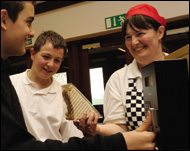 The transition from paper to electronic registers, from cashed to cashless catering, and the need for increased site security has required schools to find better ways for students to identify themselves digitally. Cards have been around for a number of years; originally incorporating a magnetic strip and more recently a proximity chip.
 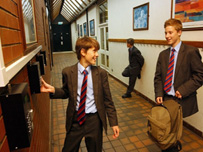 The shooting of three teenagers in south London last month may have stoked fears about kids and guns, but when it comes to school design, firearms are way down the list of security concerns. A bigger worry is arson.
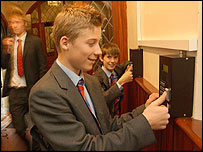 A revolutionary thumb-print register scheme has been adopted at an independent school in Leicestershire.